


Part of our Education & Childcare in Tokyo guide. Last reviewed: October 2026.
Are there international schools in Japan? Yes. Japan has dozens of international schools, concentrated in Tokyo, Yokohama, Kobe, Osaka and other major cities. Tokyo has by far the most, ranging from large American, British and International Baccalaureate (IB) schools to national community schools (French, German, Korean, Chinese, Indian and others) and smaller bilingual schools. Most teach in English, follow an August/September school year, and charge roughly 2.5 to 4 million yen a year in tuition at the best-known schools.
This guide covers which Tokyo schools offer the IB, what the best-known schools charge for 2026–27 according to their own published fee schedules, and how admissions and waitlists work.
Types of international school in Tokyo
- IB schools offering some or all of the IB Primary Years Programme (PYP), Middle Years Programme (MYP) and Diploma Programme (DP).
- American-curriculum schools, typically with Advanced Placement (AP) courses in high school.
- British-curriculum schools following the English National Curriculum to (I)GCSE.
- National and community schools following a home country’s curriculum, generally prioritising families of that nationality or language.
- Bilingual Japanese-English schools, which can suit bicultural families or those staying long-term.
- Religious schools, including Catholic schools, which usually admit families of all backgrounds.
- International preschools, many independent of the larger schools.
IB schools in Tokyo
Tokyo has a growing number of IB World Schools. Well-known examples include:
- Tokyo International School (TIS) — IB PYP, MYP and DP. Its Diploma Programme expanded with Grade 12 scheduled to open in the 2026–27 school year.
- Aoba-Japan International School — authorised for the IB PYP, MYP and DP across its Tokyo campuses.
- K. International School Tokyo (KIST) — long-established IB school offering IB programmes through to the Diploma.
- The British School in Tokyo (BST) — a British-curriculum school that introduced the IB Diploma for Years 12–13 from August 2025, replacing A levels. (I)GCSEs continue in Year 11.
- St. Mary’s International School and Canadian International School Tokyo are also listed as IB schools.
- Yoyogi International School offers the IB PYP for younger children.
Not every major school is IB: the American School in Japan (ASIJ) and the International School of the Sacred Heart, for example, follow American-style programmes with AP courses. IB authorisations change, so check a school’s current status in the IB’s official school directory at ibo.org before you apply.
International school fees in Tokyo, 2026–27
Annual tuition in Japanese yen for the 2026–27 school year, taken from each school’s published fee schedule where available. Ranges reflect different grade levels. One-time fees are charged to new students only.
| School | Annual tuition | Other annual fees | One-time fees for new students |
|---|---|---|---|
| Tokyo International School | ¥3,100,000 (K–Grade 2) to ¥3,400,000 (Grades 10–12) | Building fee ¥200,000 | ¥1,430,000 (application ¥30,000, registration ¥400,000, development ¥1,000,000) |
| The British School in Tokyo | ¥2,960,000 (Primary incl. Nursery and Reception) to ¥3,070,000 (Years 10–13) | Capital development fee ¥100,000 | Application ¥40,000; enrolment and educational resources fees ¥1,180,000 |
| Nishimachi International School | ¥3,129,000 | Education enhancement fee ¥200,000; School Growth Fund fee ¥200,000 | Registration ¥300,000; building maintenance ¥825,000 |
| International School of the Sacred Heart | ¥2,560,000 (K3–K4) to ¥2,880,000 (Grade 12) | Building/maintenance fee ¥220,000 | Application ¥30,000; registration ¥300,000; development ¥600,000 |
| K. International School Tokyo | ¥2,850,000 (Grades 1–9) to ¥3,020,000 (K1–K3) | Building maintenance ¥200,000 | Application ¥30,000; enrollment ¥300,000; capital fee ¥700,000 |
| The American School in Japan | Approximately ¥3.1–3.8 million depending on grade* | Capital assessment and optional bus* | Registration and building maintenance fees* |
*ASIJ figures are approximate, from published fee summaries; check the school’s official website for its current schedule.
What the table shows: at the best-known schools, the first year typically costs 4 to 5 million yen or more once one-time fees are included, and later years around 3 to 4 million yen. Buses, lunches, uniforms, devices, trips and activities are usually extra. Fees normally rise every year, and many employers pay fees directly or through corporate arrangements — some schools, including BST, accept corporate donations in place of tuition.
The admissions timeline
Most international schools in Tokyo follow an August/September school year. Typical timelines:
- September to January: applications open for the following August. Some schools have priority deadlines in winter; others review applications on a rolling basis until places are filled.
- Winter to spring: assessments, interviews and offers. Families who apply after the main round may be waitlisted.
- Mid-year: many schools admit mid-year where space exists, which matters for families relocating at short notice.
Every school sets its own process. Contact admissions offices as soon as a Tokyo move is likely — ideally before you sign a lease.
How waitlists work
- Entry grades are the most competitive. Pre-kindergarten, kindergarten and first grade often have the longest waitlists; places in later grades depend on how many students leave.
- Priority rules vary. Many schools prioritise siblings of current students, alumni families, and sometimes families sponsored by companies with corporate places or debentures. Ask whether your employer has an arrangement.
- Waitlists move. Tokyo’s international community is mobile, so places open in spring and summer as families relocate.
- Apply to more than one school and hold an offer while you wait.
What the application usually involves
- An application form and non-refundable application fee
- School reports from the previous two or three years
- Teacher recommendations
- Assessments, interviews or play-based observation for younger children
- An English-language assessment, and information on any learning support needs
- Passport and visa information
Be open about learning support needs. Schools vary widely in what they can offer.
How to choose the right school
- Curriculum continuity: if you may move again, choose a curriculum that transfers easily (IB, American or British) or matches your home country.
- Commute: map the school first, then look for housing. See our neighborhoods comparison.
- Total cost: compare first-year and ongoing costs, not just tuition, and confirm what your employer covers.
- Language goals: how much Japanese does the school teach, and how will you keep your home language strong? See raising bicultural kids.
- Size and community: a large school offers more programmes; a small school can feel more personal.
- Learning support: ask specifically what’s available and at what cost.
- Visit in person or virtually, and talk to current parents.
International school or Japanese school?
Not every international family chooses an international school. Japanese public schools are free, local and a fast route to fluent Japanese, and many families mix approaches — for example, Japanese daycare or kindergarten early on, then an international school later.
Legal status: a note for some families
Many international schools in Japan are not “Article 1” schools under Japanese education law. For children who hold Japanese nationality, this can matter for compulsory education and for later moves into the Japanese system. If your child is Japanese or a dual national, ask the school and your ward’s board of education how this applies.
FAQ
Are there international schools in Japan outside Tokyo?
Yes — Yokohama, Kobe, Osaka, Nagoya, Fukuoka, Sapporo and other cities have international schools, though the choice is much wider in Tokyo.
What are the best IB schools in Tokyo?
“Best” depends on your child, curriculum needs and commute. Well-known IB schools include Tokyo International School, Aoba-Japan International School and K. International School Tokyo, and the British School in Tokyo now offers the IB Diploma. Visit and compare programmes, class sizes and results.
When should we start applying?
As soon as a move is likely. For August entry, applying in the autumn or winter before gives you the best chance at popular schools.
Can we apply before we have a visa?
Usually yes — schools typically accept applications while your visa is being processed, though enrollment requires a valid status of residence.
Sources and official information
- Tokyo International School — School fees 2026–27
- The British School in Tokyo — Fees and IB Diploma from August 2025
- Nishimachi International School — Tuition and fees
- International School of the Sacred Heart — Tuition and fees
- K. International School Tokyo — School fees
- International Baccalaureate — Aoba-Japan International School and the IB’s official school directory at ibo.org
- Tokyo Metropolitan Government — International schools in Tokyo
Fees, deadlines and IB authorisations change every year — confirm with each school. TokyoParents has no commercial relationship with any school listed. See our editorial policy.
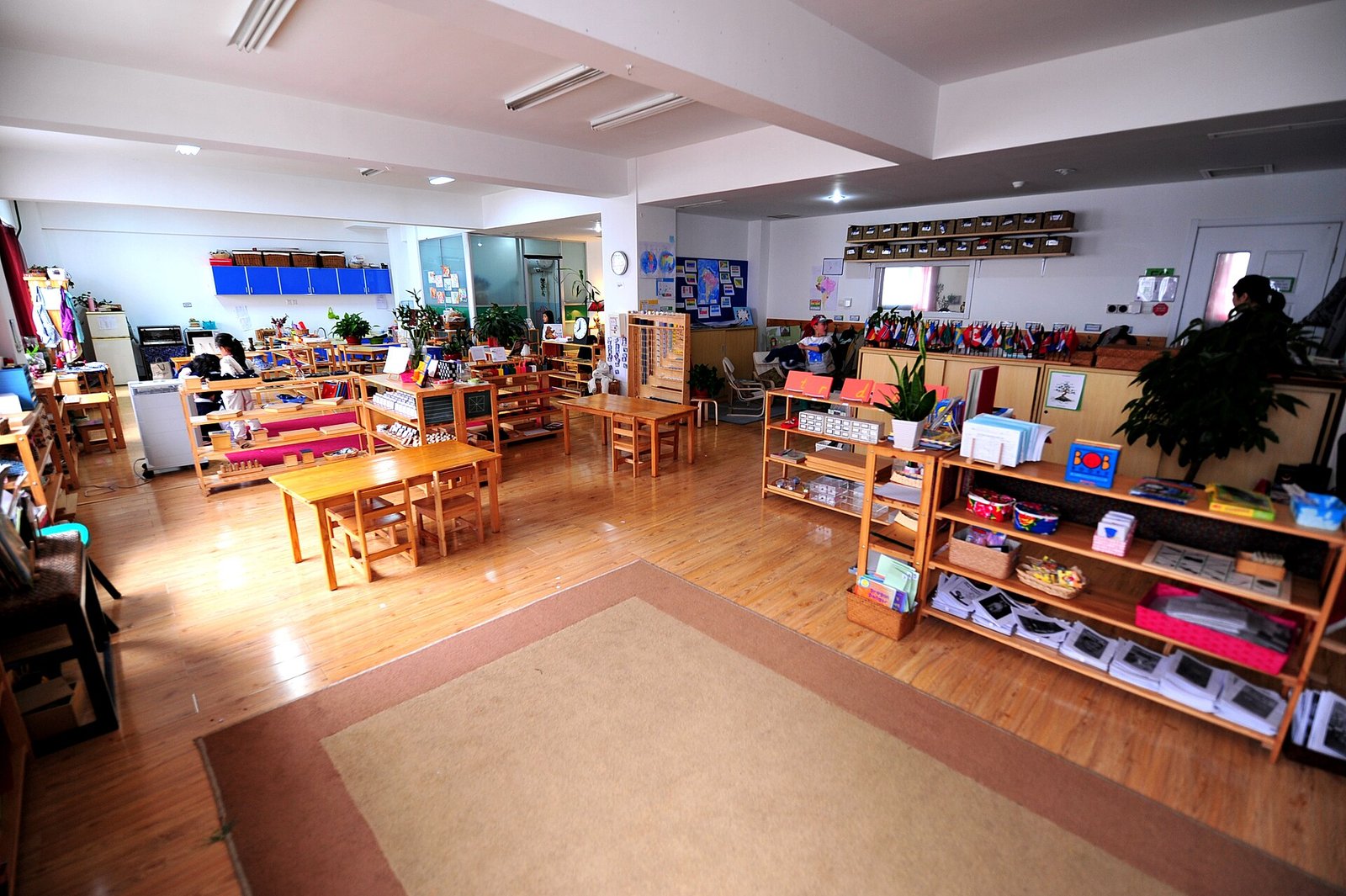
Featured image: A Montessori Classroom at Qingdao Amerasia International School by Natalie Choi, licensed under CC BY-SA 4.0, via Wikimedia Commons.