

Part of our Living in Tokyo with Kids guide. Last reviewed: October 2026.
Living with earthquakes is part of life in Tokyo, and the city is among the best-prepared in the world. For parents, though, the hardest question isn’t about buildings — it’s this: if a big earthquake hits on a weekday, who picks up the children, and how? Tokyo’s rules for schools, daycares and commuters are designed for exactly that scenario, and knowing them in advance makes a family plan much simpler.
Rule 1: schools and daycares keep children until an adult collects them
After a strong earthquake during school hours, Tokyo schools and daycares generally don’t send children home on their own. They keep children safe on site until a parent or registered guardian comes to collect them — a process called hikiwatashi (引き渡し, handover). Bunkyo, for example, keeps children at school until a guardian arrives if an earthquake of seismic intensity 5-lower or stronger occurs. Thresholds and procedures vary by ward and school.
- Handover cards: most schools and daycares ask you to register, in advance, the adults allowed to collect your child (引き取りカード). Register at least one backup adult who lives or works nearby.
- Children are safe waiting. Schools hold stockpiles and plan for children to stay overnight if needed. You don’t need to rush in dangerous conditions.
- Ask for the plan. Ask your school or daycare for its disaster manual in writing, including the intensity threshold, where children will be and how parents will be contacted.
Rule 2: Tokyo asks commuters to stay put for up to three days
To prevent dangerous crowding, Tokyo’s ordinance on people unable to return home asks workers to stay at their workplace (or another safe place) after a major earthquake, rather than all trying to go home at once — with national guidance assuming people wait about 72 hours before heading home in stages. Employers are expected to keep staff safely on site and to stock supplies.
For parents, this creates a real dilemma. Talk to your employer now about how its disaster plan treats parents of young children, and build your family plan around the possibility that one or both parents can’t get across the city quickly. That’s why a nearby backup adult on your child’s handover card matters so much.
Your family disaster plan
- Know your evacuation sites. Each ward publishes evacuation sites (often schools and parks) and hazard maps for flooding and fire. Walk the route with your children.
- Agree a meeting point near home and a second one further away in case the area is closed.
- Decide who collects each child under different scenarios (both parents at work, one parent travelling, phones down).
- Register backup adults on every handover card, and make sure those adults know.
- Agree how to communicate — see below.
- Practise. September 1 is Disaster Prevention Day, and schools hold drills around then. Use it as a reminder to review your plan.
Staying in touch when networks are overloaded
- Disaster message dial 171: dial 171, then 1 to record a message (up to 30 seconds) or 2 to play one back, using a phone number your family agrees on in advance (usually your home or a parent’s mobile). It opens after major disasters, and you can practise on the 1st of every month.
- Web171: the online version of the same service.
- Messaging apps: data messaging often works when voice calls don’t. Make sure everyone uses the same app.
- The Tokyo Bousai (Tokyo Disaster Prevention) app: official, available in English, with alerts, maps and preparedness guides.
- An emergency contact card in each child’s bag with parents’ names and numbers, the school, and a contact outside Tokyo.
A home kit that works for kids
Keep at least three days of supplies at home, and a lighter grab bag by the door.
- Water (about 3 litres per person per day) and food your children will actually eat
- For babies: formula, bottles, clean water, diapers, wipes and baby food
- Children’s medicines, allergy medication, and copies of prescriptions
- Copies of passports, Residence Cards, insurance cards and the child medical subsidy certificate
- Torch or headlamp, portable radio, power banks and batteries
- A portable toilet kit — water and sewage may be out
- Warm clothes, blankets, shoes by each bed
- A comfort item and small games or books
- Cash in small notes and coins
Make your home safer
- Anchor tall furniture and appliances to walls, especially in children’s rooms.
- Keep heavy objects off high shelves and away from beds and cots.
- Apply shatter-resistant film to glass where possible.
- Teach children “drop, cover, hold on” and to stay away from windows.
- Know where your gas meter shut-off and breaker are.
If you’re still choosing a home, newer buildings built to current earthquake standards, and the area’s hazard map, are worth considering alongside schools and space.
FAQ
Should I rush to my child’s school after an earthquake?
Only when it’s safe. Your child will be looked after at school, and walking through a damaged city or crowded stations can be dangerous. Follow official guidance and your school’s instructions.
What if I’m stuck at work for days?
That’s what the backup adult on your handover card is for. Choose someone who lives or works near the school and agree the plan in advance.
Where can I get information in English?
The Tokyo Bousai app and NHK World provide English-language disaster information.
Sources and official information
- Tokyo Metropolitan Government — Handbook on measures for people unable to return home (Japanese PDF)
- Cabinet Office — Guidelines on large numbers of people unable to return home (Japanese PDF)
- Ministry of Internal Affairs and Communications — Disaster message services, including 171 (Japanese)
- Bunkyo City public school — Notice on handing children over to guardians after earthquakes (Japanese PDF)
Follow official instructions during an emergency. See our editorial policy.
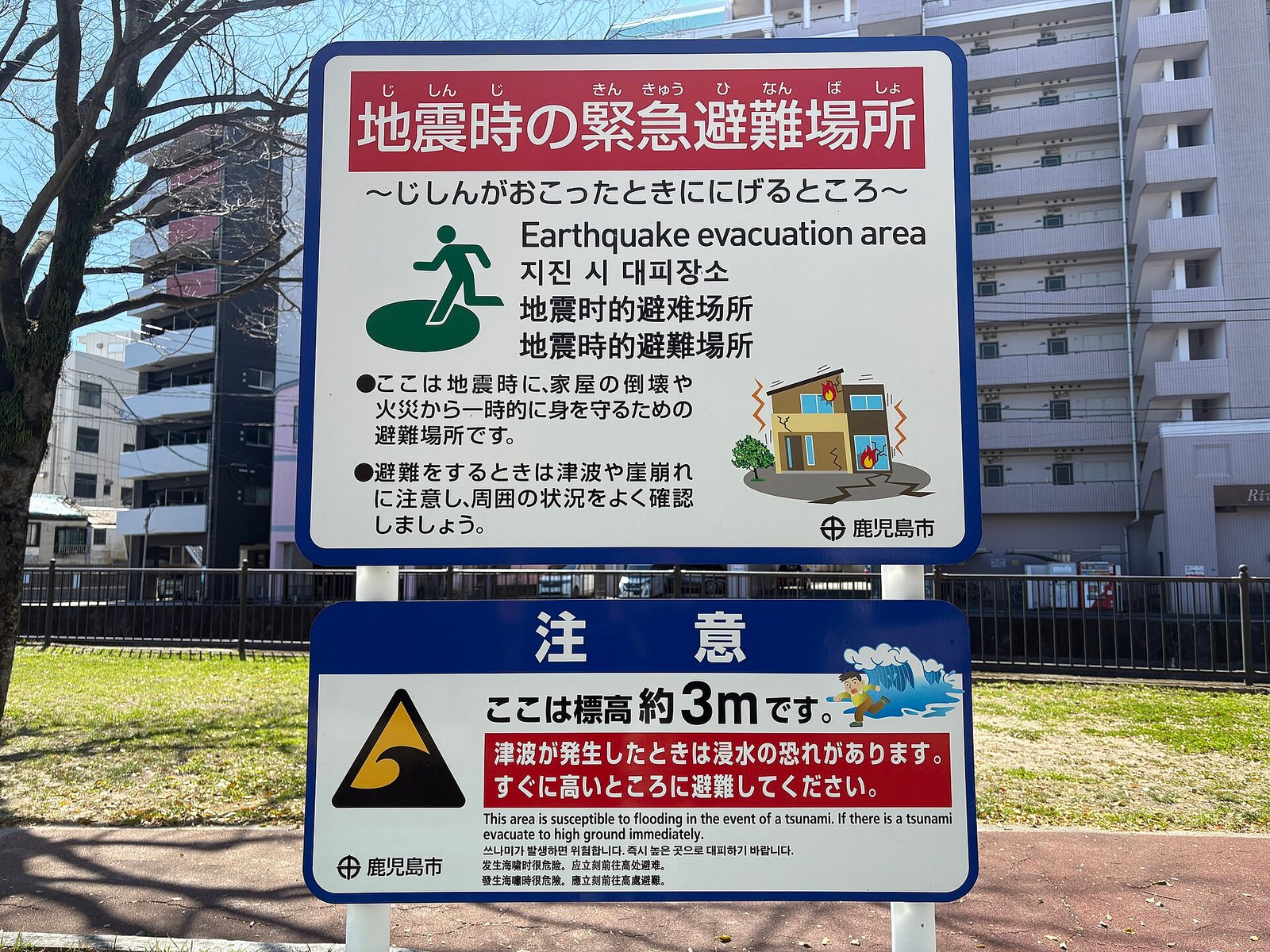
Featured image: Earthquake evacuation area sign, Kagoshima by あじさか, licensed under CC BY-SA 4.0, via Wikimedia Commons.