


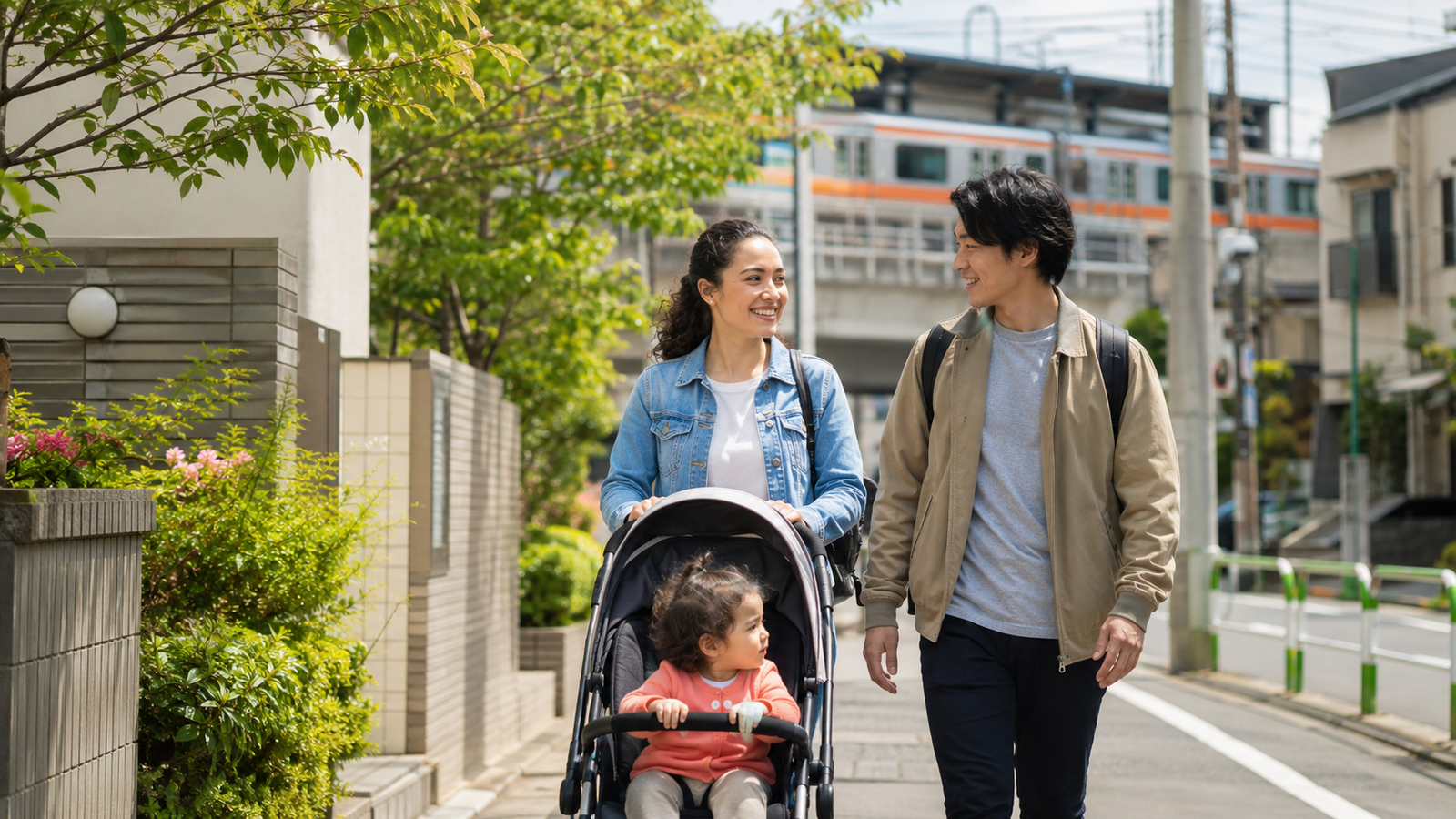
Family-friendly areas in Tokyo cannot be ranked responsibly with one “best wards” list. A neighbourhood that works beautifully for a bilingual preschool family may fail a household needing a direct commute, public-school continuity or more space. The smarter method is to compare daily systems, then shortlist actual stations and streets.
Quick answer: Start with Minato, Setagaya, Shibuya, Meguro, Koto, Nerima and western Tokyo as broad search profiles, but make the final decision at neighbourhood level using commute, housing, childcare, schools, healthcare, parks and disaster information.
Family-friendly areas in Tokyo: seven useful profiles
1. Minato: international access and central convenience
Minato attracts families seeking central access, international services and proximity to many schools and employers. The trade-offs can include housing cost, smaller space and intense competition for particular services. Compare stations rather than treating the entire ward as identical.
2. Setagaya: residential scale and family routines
Setagaya contains varied residential neighbourhoods, parks and family services. It is geographically large, so travel time to a station and the specific rail line matter. A pleasant address can still create a tiring commute if transfers are poor.
3. Shibuya: central living with sharp neighbourhood differences
Shibuya Ward includes busy commercial zones and quieter residential districts. Families prioritising central access may benefit, but must test noise, pedestrian flow, housing size and school routes at the exact location.
4. Meguro: connected residential living
Meguro is often considered for its access and residential feel. Availability and price can be limiting. Check hills, narrow streets, stroller routes and actual walking time because map distance does not capture daily effort.
5. Koto: waterfront space and newer family districts
Parts of Koto offer modern housing, parks and family-oriented development. Families should assess crowding on transport, wind and heat exposure, childcare capacity, flood information and access to their preferred schools or workplace.
6. Nerima: space and value trade-offs
Nerima may appeal to households seeking more residential space or a calmer environment while remaining in Tokyo. The key question is whether the commute and late-evening return remain sustainable for both guardians.
7. Western Tokyo: larger-scale living beyond the centre
Cities such as Musashino and other Tama-area locations can offer greenery, strong local centres and a different space-to-cost balance. They are not interchangeable. Model the total journey, childcare availability and access to specialist services.
Use a family location scorecard
| Factor | Suggested weight | What to measure |
|---|---|---|
| Commute | 20% | Door-to-door time, transfers, crowding |
| Housing | 20% | Total cost, space, storage, building access |
| Education | 15% | Assigned school or target-school route |
| Childcare | 15% | Realistic options, hours, application route |
| Healthcare | 10% | Clinic and urgent-care access |
| Daily environment | 10% | Parks, groceries, noise and walkability |
| Resilience | 10% | Hazard maps, evacuation and building factors |
Adjust the weights before viewing apartments. This prevents a beautiful property from quietly overriding your real priorities.
Test the actual neighbourhood
- Travel from work to the property during rush hour.
- Walk the school or daycare route with a stroller if relevant.
- Check supermarkets, clinic, pharmacy and park access.
- Visit once after dark and once on a weekend.
- Review official hazard maps and evacuation information.
- Listen for trains, roads, nightlife and construction.
- Calculate the full monthly cost, not rent alone.
School and childcare reality
Living in a ward does not guarantee admission to a preferred childcare facility or international school. Public-school assignment and transfer rules require local confirmation, while international schools use their own admissions. Keep school and childcare applications separate from housing marketing claims.
Use our schools guide and childcare guide before signing a lease.
Housing questions families forget
- Can a stroller reach the unit without stairs?
- Is bicycle or stroller parking available?
- How is rubbish sorted and collected?
- Are instruments, pets or home working restricted?
- What are renewal, management and move-in costs?
- Is the route comfortable during rain and summer heat?
Avoid the “best ward” trap
Ward averages hide street-level differences. A home five minutes from a station may outperform a larger home involving a bus and two rail transfers. Conversely, more space near a park may be worth a longer commute for a remote-working household. Optimise for repeated weekdays, not occasional sightseeing.
Your next action
Choose three station areas, score them with the same criteria and complete two test journeys before applying for housing. Families relocating should follow the full sequence in our moving to Tokyo with children guide.
Neighbourhood conditions, school arrangements, rents and service availability change. Verify current details with official authorities and service providers.